

Cutting off Immigration breaks the Economy
From American Mass Deportations to Brexit declines
Last week I opened a poll for this week’s topic. Your choices were 1) Ukraine&Nvidia, 2) Made in America smartphones, 3) Russia must surrender, and 4) Immigration. You overwhelmingly voted for the immigration story. Thank you all for your votes.
So, let’s go.
Immigration and Wages
The Chapter on immigration in my book begins with a premise “On one hand, the US economy needs these workers for jobs that the existing population of Americans isn’t willing to do. On the other hand, having a class of workers on the border of legal status brings down wages and creates an unfair advantage for those businesses choosing to employ migrant workers.”

The argument that immigrants bring down wages - or steal jobs from the native population - is one repeated in media, so I wanted to find out supporting evidence.
Long story short, there isn’t much there.
There is the Brookings Institute paper from 2012 that says
“Based on a survey of the academic literature, economists do not tend to find that immigrants cause any sizeable decrease in wages and employment of U.S.-born citizens (Card 2005), and instead may raise wages and lower prices in the aggregate (Ottaviano and Peri 2008; Ottaviano and Peri 2010; Cortes 2008).”
In the Ottaviano and Peri paper from 2010, they looked at the effects of immigration on the wages of native US workers of various skill levels. This study concludes that “in the period from 1990 to 2006 immigration had a small effect on the wages of native workers with no high school degree (between 0.6% and + 1.7%). It also had a small positive effect on average native wages (+ 0.6%)”.
The Cato Institute argued in 2017 that if immigration was further restricted, two things would follow.
First, certain low-skilled jobs would be automated. Automation would have a number of other economic consequences, but it certainly would not raise wages in those same low-skilled jobs.
Second, the number of high-skilled women in the workforce would decline, as there would no longer be immigrant-dependent low-cost childcare available.
Following this line of thought, restricting immigration could result in automated work places that offer jobs to a few men. The rest of the men and the women currently working in low-skilled jobs would either become unemployed or train for higher paid jobs.
Cato Institute concludes that “restricting immigration will not have a substantial positive impact on native wages, at least in real terms.”
I did find one study that supports the argument that immigration brings down wages. This is the paper by Steven A. Camarota, The Wages of Immigration: The Effect on the Low-Skilled Labor Market, The Center for Immigration Studies, January 1, 1998.
This study looked at effect of immigration to low-skilled labor markets. It found that in general, a one percent increase in the immigrant composition of an individual low-skilled occupation reduces the weekly wages of natives in the same occupation by about 0.5 percent. According to this paper, since roughly ten percent of the labor force at the time of this study was composed of immigrants, these findings suggest that immigration may reduce the wages of the average native worker by perhaps five percent.
This 1998 study is directly at odds with the 2010 study that says “in the period from 1990 to 2006 immigration had a small effect on the wages of native workers with no high school degree (between 0.6% and + 1.7%).”
Increased immigration in low-skilled labor markets would therefore at worst lower wages 5% but it could also increase them 1.7%. Increased immigration in all skill levels would increase all average native wages by 0.6%.
Mirroring this study to what the Cato Institute and the Brookings Institute argue, if immigration was restricted, rather than the wages in low-skilled labor markets rising back up, those jobs would be automated.
What about the highly skilled?
Let’s look at the H1-B Visa case. Since its introduction in 1990, there have been many studies on its affect on the US tech industries and the overall economy.
There is this Cato Institute story from 2022, titled “H‑1B Wages Surge to the Top 10% of All Wages in the US”.
“Opponents of the H‑1B visa often claim that H‑1B employers “pay low wages.” This has never been true, but the latest wage data prove how ridiculous this claim is. H‑1B workers are highly paid: their wages are in the 90th percentile of all wages in the United States, meaning that they have wages in the top 10 percent of U.S. wage earners. H‑1B workers are not low wage or “cheap” workers in any honest assessment of the meaning of those words.”
Figure 1 below is from the article, demonstrating how in 2021 the H1-B salaries surpassed the 90th percentile of all U.S. wages.
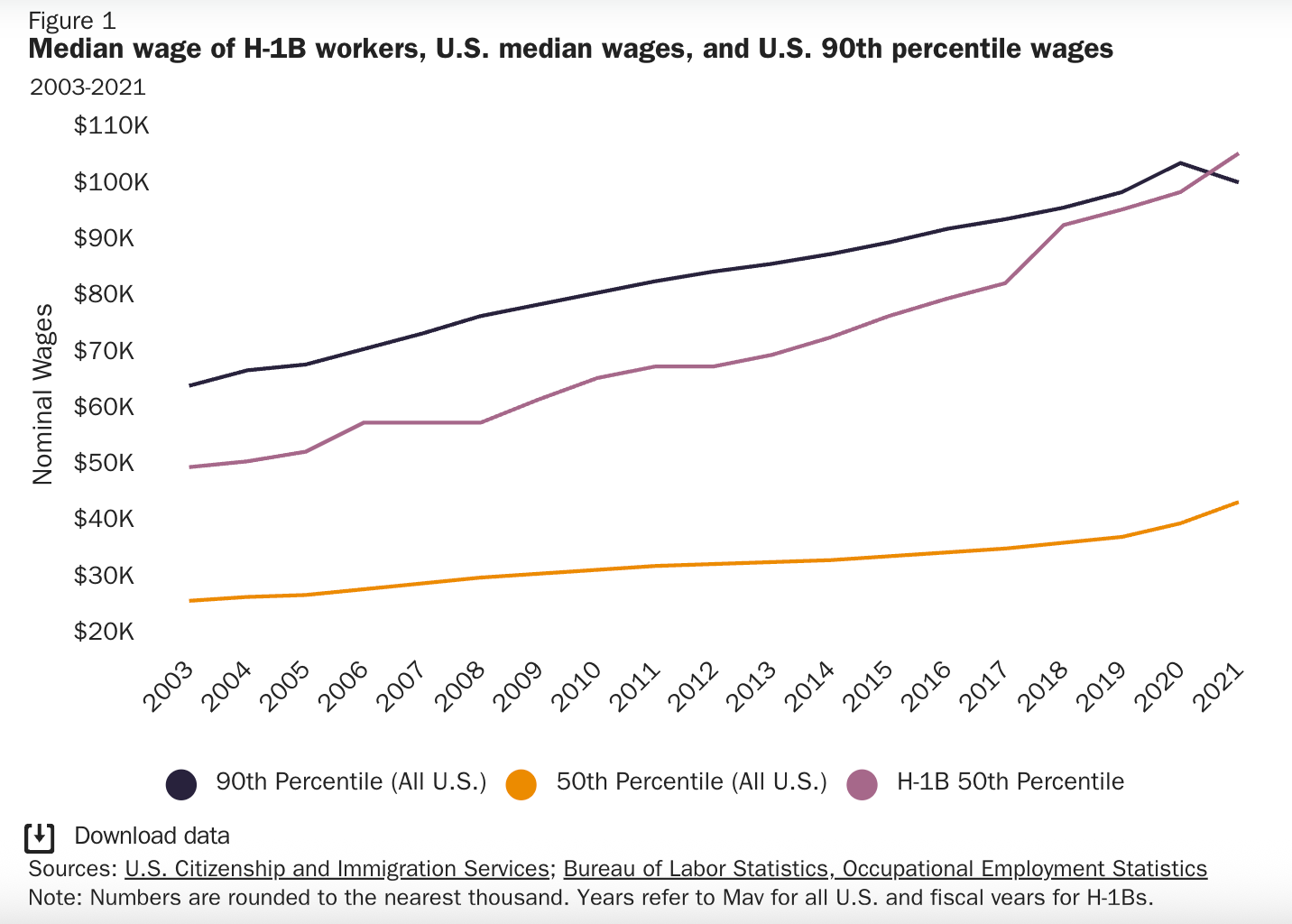
But as the diagram suggests, this wasn’t always the case. In the past immigrants in certain tech jobs were indeed paid less than their native colleagues.
This 2017 paper Understanding the Economic Impact of the H-1B program on the U.S. by National Bureau of Economic Research focused on H1-B computer scientists working between 1994-2001. It concludes that
“In the absence of immigration, wages for US computer scientists would have been 2.6% to 5.1% higher and employment in computer science for US workers would have been 6.1% to 10.8% higher in 2001. On the other hand, complements in production benefited substantially from immigration, and immigration also lowered prices and raised the output of IT goods by between 1.9% and 2.5%, thus benefiting consumers. Finally, firms in the IT sector also earned substantially higher profits due to immigration.”
To put it in plain English, immigrants came to Silicon Valley and helped it launch the tech giants that have in part made America the absolute success story it is. The immigrants that remain in those tech jobs are paid higher wages than natives, which indicates they are here because companies cannot replace them with home grown talent.
Half Of The 2025 U.S. Nobel Prize Winners In Science Are Immigrants
Of course, the H‑1B program has its problems. In any large scale program like this, you will find people who will find a way to misuse it.
However, the biggest flaw isn’t that someone is misusing the program. The biggest flaw is that we as a nation don’t fully utilize the resources ourselves.
According to the Cato Institute, “H‑1B workers should be able to receive promotions, change jobs, and start businesses without onerous government restrictions. DHS should automatically send them green cards shortly after their arrival without needing to undergo yet another bureaucratic and expensive effort that is often delayed by ridiculously low and outdated caps, both overall and on immigrants from specific countries.”
We invite highly skilled people over, and then as their visa runs out, do not allow them to stay, change jobs or start new companies and benefit the society.
Mass Deportation - Devastating Costs to America, Its Budget and Economy
I read about this study last week, pitched it to you, but only now realized it was from 2024.
Nevertheless, it’s a solid calculation what would happen to the U.S. economy if the planned Mass Deportation of 11 million people would take place, as was Tom Homan’s campaign promise last year. And to be fair, we don’t have the economic numbers from this year to draw any fresh conclusions of 2025 yet.
So, in October 2024, The American Immigration Council calculated that the cost of a one-time mass deportation operation would cost at least $315 billion, emphasizing that this figure is a highly conservative estimate.
In order to estimate the costs of a longer-term mass deportation operation, they calculated the cost of a program aiming to arrest, detain, process, and deport one million people per year—paralleling the more conservative proposals made by mass-deportation proponents in 2024.
Even assuming that 20 percent of the undocumented population would “self-deport” under a years long mass-deportation regime, the institute estimates the ultimate cost of such a longer operation would average out to $88 billion annually, for a total cost of $967.9 billion over the course of more than a decade.
Cost to the Economy
Beyond the direct financial cost of mass deportation, the American Immigration Council also estimated the impact on the U.S. economy.
“Due to the loss of workers across U.S. industries, we found that mass deportation would reduce the U.S. gross domestic product (GDP) by 4.2 to 6.8 percent. It would also result in significant reduction in tax revenues for the U.S. government. In 2022 alone, undocumented immigrant households paid $46.8 billion in federal taxes and $29.3 billion in state and local taxes. Undocumented immigrants also contributed $22.6 billion to Social Security and $5.7 billion to Medicare.
Mass deportations would cause significant labor shocks across multiple key industries, with especially acute impacts on construction, agriculture, and the hospitality sector. We estimate that nearly 14 percent of people employed in the construction industry are undocumented. Removing that labor would disrupt all forms of construction across the nation, from homes to businesses to basic infrastructure. As industries suffer, hundreds of thousands of U.S.-born workers could lose their jobs.”
A year later we are already seeing signs of this.
And then, of course there is the human cost in all of this. Separating family members, families living in fear, afraid to go to work, to school, or to their court hearings has a massive, unimaginable unnecessary cost to our communities.
What about Brexit then?
For my book I consulted Jonathan Portes who looked at how immigration policies and migration flows have changed starting from before the EU referendum in 2016 and up until early 2021 when the UK passed a new post-Brexit migration policy.
“In our paper for the OXREP special issue on Brexit in 2017, Portes and Forte, we drew on two papers that used cross country evidence to estimate such impacts and incorporated their estimates into our assessment of the impacts of post-Brexit changes to immigration. This led to much larger negative impacts, of between 3 and 8% to GDP, and 1 to 5% to per-capita GDP.”
Today, it has been almost a decade since the 2016 referendum for the UK to leave the European Union, and there is much more post-Covid data available.
This CEPR study - fresh from the oven published December 5th, 2025 - by Nicholas Bloom, Philip Bunn, Paul Mizen, Pawel Smietanka, Gregory Thwaites combine simulations based on macro data with estimates derived from micro data. These estimates suggest that by 2025, Brexit had reduced UK GDP by 6% to 8%, with the impact accumulating gradually over time. Investment, employment, and productivity were all affected, reflecting a combination of elevated uncertainty, reduced demand, diverted management time, and increased misallocation of resources. Investment was 12–18% lower, employment 3–4% lower, and productivity 3–4% lower.
This study does not single out changes in immigration as the cause for the economic hardship, but if we compare it to what actually happened to immigration in the UK post Brexit we get a clearer picture.
The reasons for Brits to vote to leave the European Union were mainly related to sovereignty, they felt that the EU is dictating too much of what the UK can and cannot do, and the biggest pain point was immigration. Since the EU expanded in 2004 to include more Eastern European countries, many in those countries used the opportunity to search for a better life in the UK.
According to this 2025 European Parliament Think Tank piece, post-Brexit immigration to the UK actually increased. Only now it was not EU citizens, but people from other countries.
“The free movement of people between the EU and the UK ended on 1 January 2021, with the conclusion of the transitional period outlined in the withdrawal agreement signed in January 2020. Leaving the EU in 2016 allowed the UK to implement a points-based system that treats EU citizens and non-EU citizens equally. In the following years, there was a significant increase in the number of migrants arriving in the country. The sharp rise in the number of regular migrants can be attributed to the liberalisation of migration laws, making it easier for non-EU migrants to work in the UK, a campaign aimed at attracting more foreign students, and the high number of visas granted to people from Ukraine and Hong Kong on humanitarian grounds. Additionally, there has been a notable shift in the composition of these migrants in terms of age and nationality. Prior to 2016, most migrants came from the EU, but now most come from outside the EU.”
What’s next for Britain?
This Economics Observatory article How might the UK’s new approach to migration affect the economy? writes that in May 2025 the Labour government announced further measures to restrict migration (Migration Observatory, 2025). It shortened the list of occupations eligible for work visas, closed the care route for overseas recruitment, and said it would seek to reduce employers’ reliance on overseas workers while boosting the supply of domestic skills.
“The first five years of the post-Brexit immigration system have been a rollercoaster ride. Policy liberalisations enabled net migration to reach a record high, followed by a record fall. They also shifted the source of migrant arrivals from EU to non-EU countries. Academic research suggests that house prices are where the effects of migration are most noticeable, while its impact on the UK’s labour market and public finances is likely to be small. The government is hoping to bring down net migration further by reducing employers’ demand for overseas workers, but without the right incentives it will find it difficult to influence employers’ behaviour.”
Conclusions
In the U.S. immigration in low skilled sectors had a small effect on the wages of native workers with no high school degree (between 0.6% and + 1.7%). Construction, agriculture, and the hospitality sector are especially reliant on immigrants.
In the U.S. immigration in high skilled sectors enabled the growth of its tech industry giants, which continue to rely on immigrants in highly paid innovation jobs. In 2025 half of American Nobel laureates were immigrants.
The UK cut itself off of the EU, which in turn stopped European immigration, then GDP dropped 6-8%. Getting back to growth traction is proving difficult.
Immigration policies need to be carefully crafted so they benefit the economy, produce an upside to the native population, and are humane. The perceived negative effects of immigration possibly rising wages in the low-skilled sectors in the U.S. or the potentially higher housing prices in the UK are problems that can be addressed with wage and housing policies. The vast amount of data from many industrialized countries support the idea of smart immigration policies.
(I don’t have time to cover Canada here, but listen to the chapter below from my audiobook to get the Canadian experience).
As Dr. Nancy Allbritton, Dean of the Frank and Julie Jungers Dean College of Engineering, University of Washington voiced in the Senate Commerce Committee hearing of the CHIPS and Science Act in the Fall of 2022:
“We need all the talent we can get. If you look at any university in the US you can see that the talent comes from across the world. Many of the companies we’re talking about, their founders are not from the US but they have found home here. So being an open and welcoming space gives us a technological advantage that we can capitalize so that we have a brain-collective in the US. We’ll be richer, more diverse, and more productive as a result.”
America, look at Brexit as a cautious tale. Breaking the social, industrial and economical fabric of a country is fast, but rebuilding will take decades.
Free sample of my audiobook - Chapter on Immigration:
Thank you and enjoy the rest of your week, wherever you are <3
About Deep Policy
Stay relevant and connect the dots.
Hi, I’m Petra Söderling. Welcome to Deep Policy, a space where I help you understand how governments, technology, and innovation policy shape the world around us.
This newsletter and blog continue the conversation I began in my book Government and Innovation – the Economic Developer’s Guide to Our Future, and on my podcast Deep Pockets with Petra Soderling. If you’ve ever wondered why governments pour billions into quantum, AI, or biotech, or how geopolitics bends the path of technology, you’re in the right place.
Every week, I share a mix of deep-dive essays, timely analysis, and cultural reflections, always with an eye toward what matters for you: the choices being made now that will shape your future economy, your industry, and your society.
Additional Resources
For more analysis, insight, maybe some entertainment, please feel free to explore these:
Petra Soderling & Co advisory services
Consulting governments, NGOs and companies on the economic and financial impact of deeptech. It’s not just me, it’s a whole team! Selected testimonials for my work from private clients can be found here. A banner with most notable public clients can be found here.
Deep Pockets Podcast
Every second week, more or less diligently, I bring forward a guest to discuss all things in the intersection of government and innovation.
The Book: Government and Innovation - the Economic Developer’s Guide to our Future
My 2022 Amazon Hot New Release (editorial pick) is divided in three sections; the Tools that governments have to create new innovative industries, Examples from five countries who’ve done it right, and a How To section for implementation. Available in paperback or hard cover.
The audiobook: Government and Innovation - the Economic Developer’s Guide to our Future
My 2022 Amazon Hot New Release (editorial pick) is divided in three sections; the Tools that governments have to create new innovative industries, Examples from five countries who’ve done it right, and a How To section for implementation. Available in paperback or hard cover.
Quantum Strategy Institute
In my role as the Head of Government and Consortium Relations at QSI, I’ve written many papers on how public quantum strategies support economic growth. Explore the full website or find my articles directly here.